How to Spot High-Quality Leather: A Buyer's Guide That Saves You Money
You are standing in a store. The jacket feels nice enough. The price is not cheap, but it is not eye-watering. The label says leather. But is it good leather? Here are the tests that tell you, before you commit.
The touch test
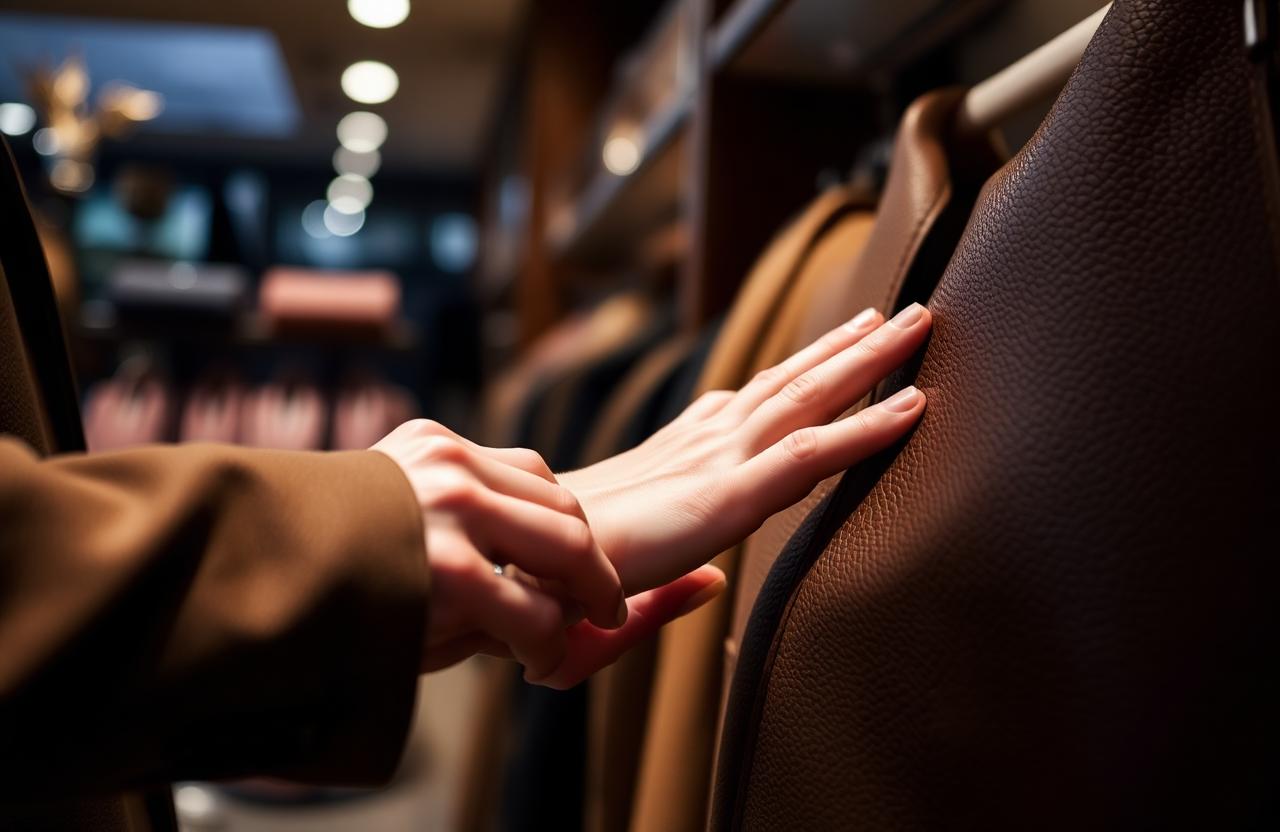
Pick up the leather and press it with your thumb. Quality leather responds like skin — it wrinkles under pressure and springs back when released, leaving a temporary impression that fades naturally. This is because the collagen fibres in full-grain leather have a natural elasticity that processed or synthetic materials cannot replicate.
If the material feels cold, rigid, or returns to its original state with no visible reaction, it is either heavily coated, bonded, or synthetic. If it feels plasticky or unnaturally smooth — like touching a phone case — step away.
Also pay attention to how the leather feels between your fingers. Good leather has a slight unevenness, a texture you can feel. Mass-produced or heavily corrected leather feels flat and lifeless.
The smell test
Bring the leather close and inhale. Genuine, well-tanned leather has a distinctive aroma — earthy, slightly sweet, warm. It is the scent of tannins, natural oils, and the leather's fibre structure. It is pleasant and complex, quite unlike any synthetic imitation.
Red flags: a strong chemical or solvent smell suggests poor-quality tanning or excessive surface coatings. A plastic or rubber smell indicates synthetic material. No smell at all — a flat, neutral character — suggests either heavy processing or a non-leather material.
The scent of leather is so distinctive that it is used in high-end fragrance composition. If the material in your hands smells nothing like what you associate with 'leather,' it probably is not worth the price.
The edge test
Examine the cut edges of the leather — the places where you can see the material's cross-section. In a jacket, check inside seams, along the hem, or at the edge of a pocket flap.
Quality leather has rough, fibrous edges. You should be able to see the individual collagen fibres — they look like fine, interlocking threads. This is the natural structure of the hide.
If the edges are perfectly smooth, painted, or rubbery, the material has been heavily processed to hide its true nature. Bonded leather edges often look like compressed cardboard. Synthetic leather edges reveal the fabric backing underneath the plastic coating.
The grain test
Look closely at the surface pattern. Natural leather has an irregular grain — the pores and markings are distributed unevenly, with subtle variations in density and direction. You may see faint natural marks: healed scratches, insect bites, or slight colour variation. These are signs of authenticity, not defects.
If the grain pattern is perfectly uniform, with identical pores repeating at regular intervals, the pattern has been artificially stamped or embossed onto the material. This is common on genuine-grade and bonded leather, where the natural surface has been removed and replaced with an artificial one.
Full-grain leather wears its history openly. The 'imperfections' are what make it real.
The weight test
Hold the jacket or bag in your hands. Good leather has substance — it feels dense and reassuring, with a weight that comes from the thickness and integrity of the hide. A full-grain cowhide leather jacket for adults typically weighs between 1.5 and 3 kilograms.
If a jacket labelled as leather feels featherlight or hollow, it is likely made from a very thin split or from bonded material. Thin leather wears through at stress points — elbows, shoulders, pocket openings — far faster than properly weighted material.
The weight of leather is not a burden; it is a promise. It tells you there is enough material to withstand years of use, enough substance to develop character, enough integrity to age rather than deteriorate.
The one rule that never fails
If the brand will not tell you the leather grade, the tannery source, or the animal origin, there is a reason. Transparency and quality are correlated. Brands that invest in superior materials want you to know about it. Brands that rely on ambiguity are counting on your trust, not your knowledge.
Ask the question. If the answer is vague — 'premium leather,' 'Italian leather,' 'hand-selected leather' without specifics — treat the product with scepticism. The answer you want to hear is specific: 'Full-grain cowhide from an LWG-certified tannery in Tuscany.' That is a brand that believes in what it sells.
Leather worth writing about.
Discover the pieces behind the words.
Visit the Collection